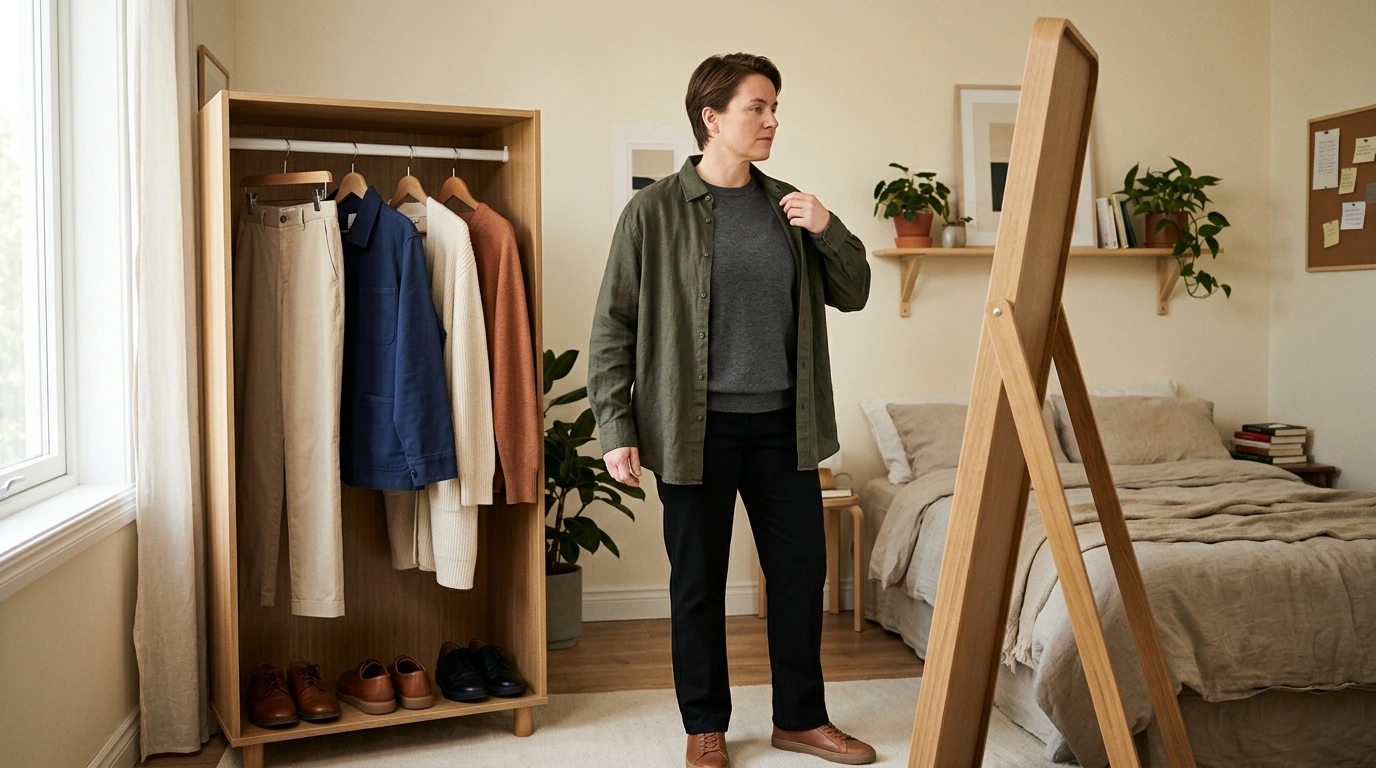
Style feels easiest when it matches identity, comfort, and daily life—not someone else’s rules. Our Inclusive Fashion Empowerment Toolkit: 10-in-1 Bundle for Genderless & Non-Binary Style is built to help you shape a wardrobe that reads the way it needs to read (or refuses to read at all) while staying practical: getting dressed faster, shopping with less stress, and building outfits that feel like home.
If you’re navigating shifting presentation, sensory needs, or just the exhaustion of gendered “dos and don’ts,” our team made this bundle to give you structure without boxing you in.
When you remove gender rules, you still need a way to decide what “works.” We use three anchors that make outfit-building feel clear instead of overwhelming.
Pick one focal silhouette per outfit—boxy, draped, tapered, oversized, longline—and keep the rest supportive. One clear shape reads intentional even when the pieces are simple.
Vertical lines lengthen, horizontal lines widen, and diagonal lines add movement and softness. “Line” can be seams, open layers, long necklaces, jacket lapels, even a bag strap.
Decide what your outfit should do today: blend, stand out, feel protected, feel open, feel sharp, feel relaxed. Then choose pieces that serve that goal.
| If the goal is… | Try silhouettes | Finish with… |
|---|---|---|
| Androgynous minimal | Straight-leg + boxy top, monochrome layers | Clean sneakers or boots, simple belt |
| Soft & fluid | Drape cardigan, wide-leg, relaxed tailoring | Light jewelry, scarf, slouch bag |
| Sharp & structured | Blazer, utility jacket, tapered trouser | Leather belt, angular frames, crisp shoes |
| Comfort-first | Stretch base + oversized layer | Slip-on shoes, cap/beanie |
If your closet feels loud but your outfits feel repetitive, the issue is usually “switch power.” A capsule that remixes well doesn’t require a huge wardrobe; it needs the right anchors and the right switches.
Outfit formulas are not uniforms that erase you—they’re a baseline that protects your energy. Once a formula fits your body and identity, you can repeat it with different textures, layers, and finishing touches.
When you’re rushed, it’s easy to default to whatever is “fine,” then feel off all day. This routine keeps the decision-making small and centered on your needs.
| Situation | Go-to base | Layer to change the vibe | Fast finishing touch |
|---|---|---|---|
| Work / meetings | Neutral top + tailored pant | Blazer or clean overshirt | Simple belt + solid shoe |
| Social night | Monochrome base | Statement jacket | One bold accessory |
| Travel day | Soft set or stretch base | Longline layer | Cap + crossbody |
| Errands | Relaxed denim or cargo | Hoodie + overshirt | Sneakers + watch/chain |
If you’re looking for clear, respectful terminology around gender identity (or sharing resources with friends/family), these are solid references: GLAAD Media Reference Guide, Human Rights Campaign glossary, and The Trevor Project’s guide to understanding gender identities.
No—genderless style can be minimal, colorful, sharp, soft, or experimental. It’s about choosing shapes, colors, and details that align with your identity and comfort rather than gendered expectations.
Shift proportions and layering first: straight-leg or wide-leg bottoms, structured outer layers, and a simplified palette can change the overall read quickly. Add one or two “switch” pieces (outerwear or accessories) to transform familiar basics.
Build two or three outfit lanes—soft/fluid, sharp/structured, and comfort-first—using shared base items. Then adjust the day’s presentation with one signal piece like a favorite jacket, accessory, or signature color.


Leave a comment