
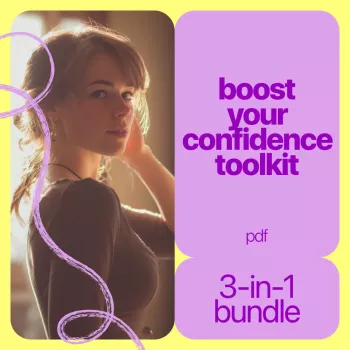
Confidence isn’t a personality trait reserved for “natural speakers.” It’s a repeatable set of skills—what to say to yourself, what to do with your body, and what to practice when nerves show up. Our team built the Boost Your Confidence Toolkit: Speak Boldly Guide, Confidence Checklist & Self-Esteem eBook to bring those pieces together in one place. You can use it before a big moment, and you can keep using it until boldness starts to feel normal.
This plan keeps friction low: one small action per day so progress feels inevitable instead of exhausting. If you miss a day, restart where you left off—confidence grows from returning, not from perfection.
| Day | Focus | Use From Toolkit | Small Action (10–20 minutes) |
|---|---|---|---|
| 1 | Baseline clarity | Self-esteem eBook | Write down three situations where you go quiet and one reason each feels risky. |
| 2 | Nervous-system reset | Confidence checklist | Run the checklist before a low-stakes conversation (barista, coworker, neighbor). |
| 3 | Speak with structure | Speak Boldly guide | Use a simple framework (one point + one reason + one example) in a message or meeting. |
| 4 | Boundary practice | Self-esteem eBook + checklist | Choose one small “no” or “not today” and deliver it calmly without over-explaining. |
| 5 | Handling mistakes | Speak Boldly guide | Practice a repair line: acknowledge, clarify, move forward (no spiraling). |
| 6 | Visibility | Checklist + Speak Boldly guide | Ask one question in a group setting or share one idea before the meeting ends. |
| 7 | Integration | All three | Review wins from the week and choose one confidence habit to repeat next week. |
Confidence rises faster when your nervous system is supported—calm creates capacity to speak and act. Stress affects the body in real, physical ways, which can show up as shaky voice, racing thoughts, or a “blank mind” response (see the American Psychological Association’s overview of stress effects on the body). If you want extra support on stress, rest, and emotional reset, pair this toolkit with The Essential Relaxation Toolkit for Inner Peace: 5-in-1 Bundle for True Rest & Calm.
If anxiety is part of your experience, it can also help to build a simple coping routine around daily stress skills (the National Institute of Mental Health’s coping guidance is a solid starting point). Our goal with the checklist isn’t to eliminate nerves—it’s to make them workable so you can still speak.
You can notice a shift within days by using the confidence checklist as a repeatable pre-conversation routine. More stable confidence typically builds over weeks as you practice the Speak Boldly methods and do the self-esteem work consistently.
Yes—“Speak Boldly” is about clear self-expression in everyday life: meetings, one-on-one conversations, boundaries, asking for help, and speaking up when it would be easier to stay quiet. You’ll use the same skills whether you’re presenting to a room or advocating for yourself in a small moment.
That’s common, and it doesn’t mean you’re doing anything wrong—it means your body is trying to protect you. Use the checklist before low-stakes conversations to train safety and momentum, then scale up to higher-stakes situations; if you want extra support, pairing confidence practice with a relaxation routine can make the sensations easier to manage.






Leave a comment