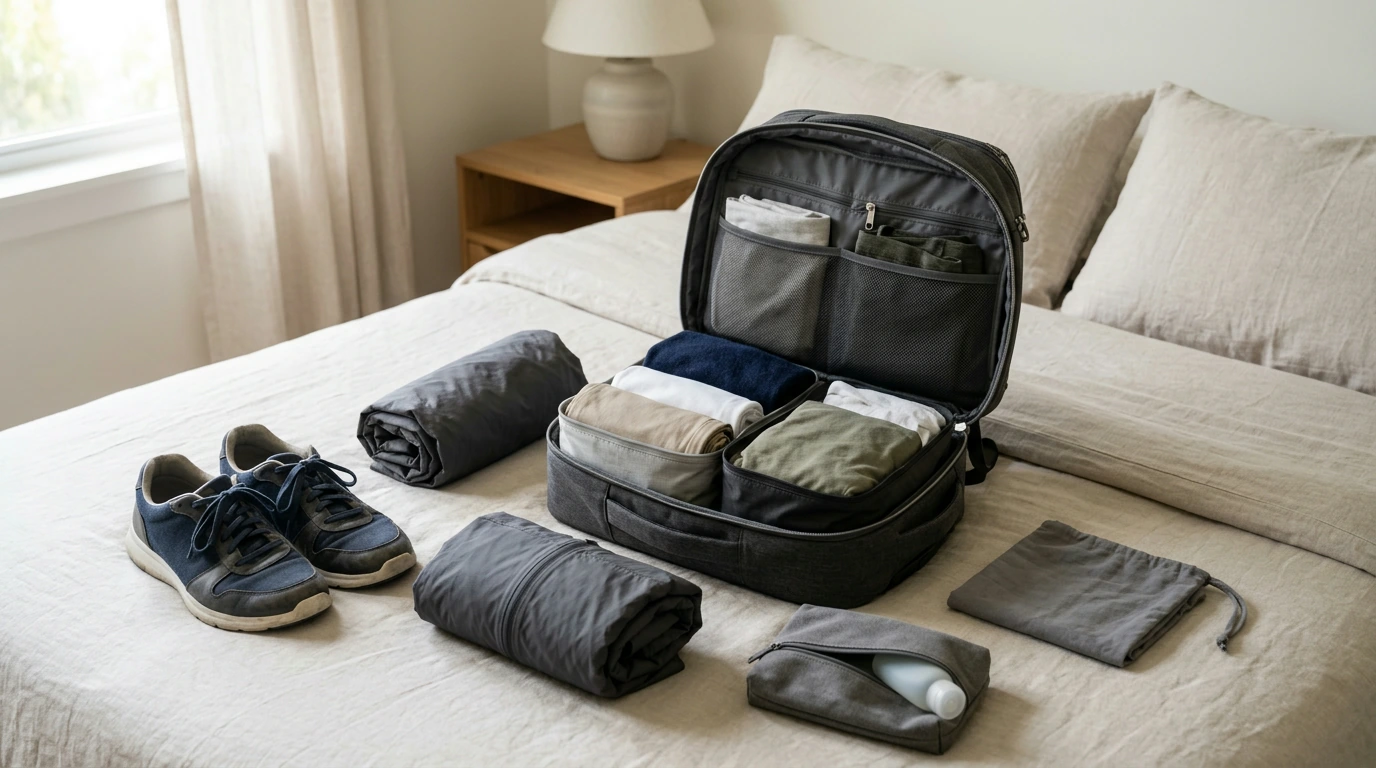
Packing light for a long trip is less about willpower and more about systems. The goal is simple: carry fewer items that do more jobs, keep everything easy to find, and stay comfortable across changing weather, activities, and laundry days. This blueprint lays out a repeatable method—so the bag stays light from day one to day thirty, without the “just in case” spiral.
Before you write “3 shirts, 2 pants,” map the trip reality. Our team starts every long-trip pack with four inputs: climate range (including night temps), city vs. nature time, how formal you’ll need to look, and laundry access (sink, laundromat, hotel service).
Next, count wear cycles—not days. If you’re doing six “active days,” four “social evenings,” and three “outdoor days” between washes, you’ll pack for those cycles and plan one reset, instead of trying to outfit every calendar square.
Set your bag boundary first (carry-on backpack, small roller, or personal item only). The bag size becomes the rule that protects minimalism. Finally, choose a simple palette—two neutrals plus one accent—so tops and bottoms mix without thought, and your shoes stay minimal.
A long-trip capsule wardrobe works because it repeats. You’re not packing “more,” you’re packing “compatible.” Aim for a tight core and let laundry do the scaling.
| Category | Target Count | Why It Works |
|---|---|---|
| Bottoms | 2 | Rotate wear; one can be washed/drying while the other is in use |
| Tops | 4–6 | Enough variety without creating decision fatigue |
| Layering mid-piece | 1 | Adds warmth and polish; doubles as plane layer |
| Outer layer (shell) | 1 | Rain/wind coverage without bulk |
| Shoes | 2 pairs | One walk-all-day pair + one alternate (dressy or trail) |
| Sleep/active | 1 set | Keeps “rest mode” separate; can double as gym wear |
| Accessories | 2–4 items | Small items create outfit variety without weight |
Choose fabrics that tolerate re-wears: merino blends, technical synthetics, and wrinkle-resistant cotton blends. Then run the “three-outfit test”: each item must complete three distinct outfits you’d actually wear. If it only works in one scenario, it’s a “maybe” that usually becomes dead weight.
For nicer moments, keep it modular: one elevated top + one versatile bottom + one compact accessory beats packing a single-use formal outfit. And for temperature swings, prioritize layers over bulk—one light insulating layer plus a packable shell covers more ground than a heavy coat.
Build a micro health kit: blister care, basic pain relief, any personal meds, and a small antiseptic option. For flying, stay current on liquid screening rules and pack so inspection is fast; the TSA’s 3-1-1 guidance is the baseline to know cold: https://www.tsa.gov/travel/security-screening/liquids-rule.
If you’ll wash on the go, add a tiny laundry mini-kit: a small detergent option and a sink stopper if your accommodations tend to be stopper-less. For broader trip health prep, the CDC’s travelers’ checklist is a solid reference: https://wwwnc.cdc.gov/travel.
Streamline documents with digital backups plus one physical copy of essentials (ID details, insurance, key reservations). Add a small security layer: strong passcodes and a plan for device loss. For baggage rules that vary by carrier and region, IATA’s overview is a helpful starting point: https://www.iata.org/en/programs/ops-infra/baggage/.
If jet lag is likely, build the capsule around night one: easy wind-down tools beat scrolling and caffeine. If you want a ready-made approach for rest and reset routines during transit, our team often pairs this packing system with The Essential Relaxation Toolkit for Inner Peace: 5-in-1 Bundle for True Rest & Calm.
If you want this method laid out as a repeatable checklist and decision system, start here: Your Packing Blueprint for Long Trips with Light Bags – Minimalist Packing Tips for Long Trips.
For a low-effort way to stay grounded on long travel days (especially when sleep is choppy), add: The Essential Relaxation Toolkit for Inner Peace: 5-in-1 Bundle for True Rest & Calm.
And if you like a small mindset cue you can use in airports, lines, and layovers, our digital pick is: Powerful Words, Powerful Mind: A Guide to Positive Mentality Quotes.
Pack for wear cycles and laundry access, not for every day on the calendar. A strong baseline is 2 bottoms, 4–6 tops, plus one mid-layer and one shell; beyond two weeks, you scale by washing on a cadence (sink or laundromat), not by adding more clothing.
Keep a consistent comfort capsule: essentials (wallet/ID/keys), hydration and a snack, wipes, a light warmth layer, and the charger/cable you’ll actually use. Add one simple rest tool (eye cover or ear protection) so you can reset without unpacking everything.
Use a three-part filter: frequency (will you really use it?), impact (what happens if you don’t have it?), and replaceability (can you buy it easily there?). Hold the bag boundary as your rule, and keep a small contingency budget so you can replace rare-use items instead of hauling extras like backup shoes, bulky jackets, or duplicate toiletries.




Leave a comment